Why leftover wall paint is the wrong answer overhead, and what a real ceiling white does differently.
Short answer: A dedicated ceiling white is formulated with higher opacity, a flatter finish and better sag resistance than wall emulsion. Ceilings are lit by raking light that exposes every joint, trowel mark and roller lap, and a flat high hiding film is what makes those disappear. Wall paint used overhead tends to drip while you work, show lap marks when dry and need an extra coat to cover. Turbolux Ultra Ceiling White is built for the job and costs less per square foot than the wall emulsion people substitute for it.
Why is ceiling paint different from wall paint?
It looks like white paint in a white bucket, so the assumption that it is interchangeable with wall emulsion is understandable. The formulation differences are real though, and they all trace back to two facts: a ceiling is horizontal, and it is lit differently from a wall.
| Property | Dedicated ceiling white | Wall emulsion | Why it matters overhead |
|---|---|---|---|
| Opacity | Very high | Moderate to high | Hides joints and old stains in fewer coats |
| Sheen | Flat | Matte to satin | Flat films scatter light so flaws vanish |
| Sag resistance | High | Standard | Less dripping onto floors and your face |
| Open time | Longer | Standard | Reduces lap marks across a large area |
| Spatter control | Formulated to reduce it | Not a design priority | Cleaner work when rolling overhead |
Light is the key point. A wall is usually lit from the side by a window, but a ceiling is lit by light bouncing up off the floor and by fixtures mounted on it. That produces a low angle grazing light across the whole surface, which is the harshest possible way to view a flat plane. Any sheen at all turns every plasterboard joint, patch and roller lap into a visible line.
What goes wrong with wall emulsion overhead?
Using leftover wall paint on a ceiling rarely fails outright. It just produces a result that looks slightly wrong and nobody can explain why.
Lap marks. A ceiling is one large uninterrupted plane with no natural stopping points. Wall emulsion sets faster than ceiling paint, so where a freshly rolled section meets one that has started to dry, you get a visible band.
Sheen flashing. Even a matte wall emulsion carries slightly more sheen than a true flat. Under grazing light that sheen picks out every imperfection in the plaster below.
Extra coats. Lower opacity means the old ceiling colour and any faint staining reads through, so you end up applying three coats of a more expensive paint where two of a ceiling white would have covered.
Mess. Lower sag and spatter resistance means more paint on the floor, the furniture and you.
Should a ceiling always be white?
Not always, but white is the default for good reasons, and in Kerala homes those reasons are stronger than usual.
White reflects the most light back into the room. In houses where deep verandas and roof overhangs shade the windows, and where monsoon skies cut daylight for weeks, that reflected light makes a genuine difference to how a room feels. A white ceiling also visually lifts the plane, which matters where floor to ceiling heights are modest.
There are cases for going off white or coloured. A very tall room can feel more intimate with a soft grey or warm off white ceiling. A small feature room, a study or a home theatre can carry a darker ceiling well. If the walls are a strong colour, taking the ceiling to a soft tint of that colour rather than pure white avoids a harsh line at the top. For more on how ceiling and wall choices interact in compact rooms, see interior colours that make small rooms look bigger.
How do you deal with ceiling stains and damp patches?
This is where most Kerala ceiling jobs actually go wrong, and no paint solves it.
A brown or yellow ring on a ceiling is a water stain, and it means water reached the slab from above. Painting straight over it does two things: the stain bleeds back through within weeks, and the underlying leak keeps working on the concrete and the reinforcement inside it.
The sequence has to be:
- Find and fix the source. Usually a terrace waterproofing failure, a cracked slab, or a leaking pipe or bathroom above. Our guides on roof leakage repair and terrace waterproofing cover the common causes.
- Let the slab dry completely. This can take weeks after a leak is sealed, especially in monsoon. Paint applied over a damp slab will blister.
- Scrape back all loose material and treat any mould with a suitable wash, then let it dry.
- Prime, then paint. An interior primer over the repaired area stops the patch absorbing differently from the rest of the ceiling.
Black speckled mould rather than a brown ring usually points to condensation and poor ventilation rather than a leak, common in bathrooms and closed rooms. Fixing airflow matters as much as the coating there.
Which Turbolux products should you use?
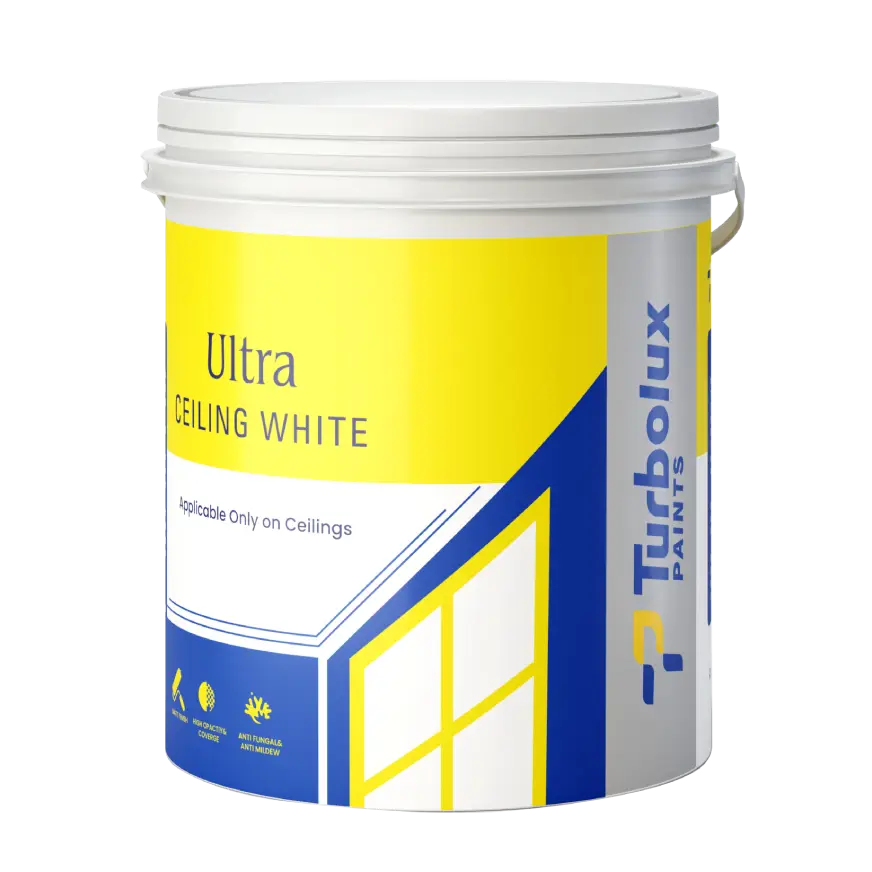
A dedicated ceiling paint with a flat high hiding film that conceals imperfections.
Green AssuredView Ultra Ceiling White →
A water based undercoat for bare slabs and repaired ceiling patches.
Water-Based UndercoatView Interior Primer →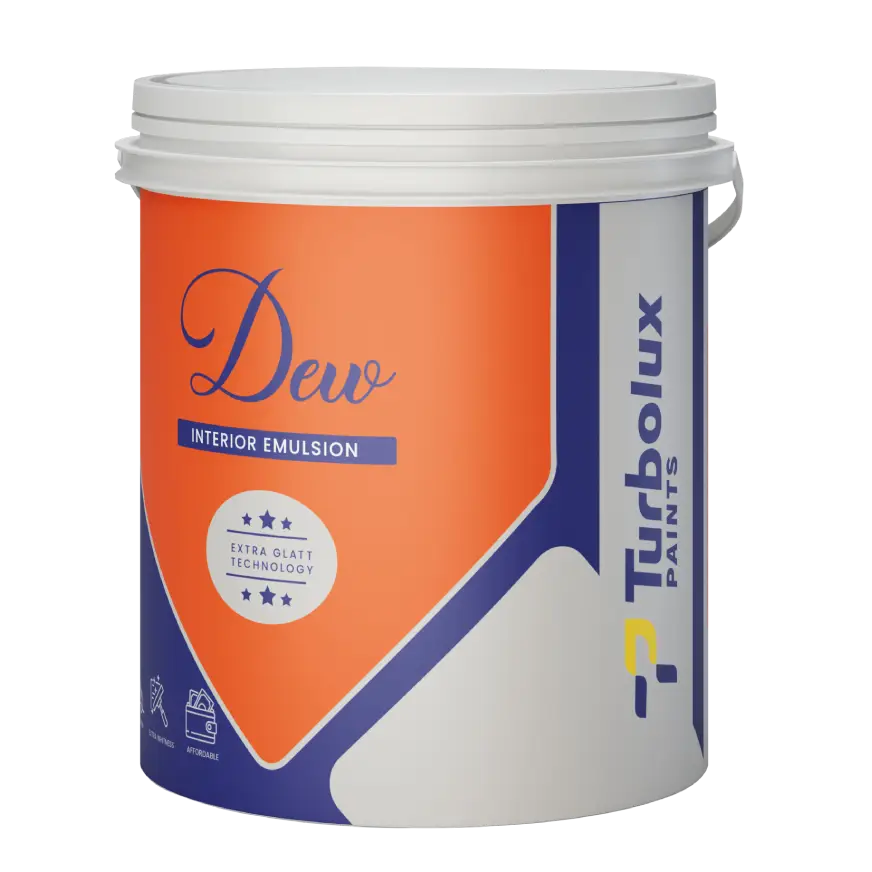
A silky matte interior emulsion for the walls that meet your new ceiling.
Silky Matte FinishView Dew →How do you paint a ceiling properly?
- Do the ceiling first. Always paint the ceiling before the walls, so any spatter gets covered later.
- Clear and cover. Remove or sheet everything below, including fan blades and light fittings.
- Clean and repair. Brush off cobwebs and dust, fill cracks, sand smooth, spot prime repairs.
- Cut in the edges. Brush a 50 to 75 mm band around the full perimeter and around fittings before rolling.
- Roll in one direction, wet edge maintained. Work in sections of about 3 by 3 feet, always overlapping into paint that is still wet. Do not stop halfway across a ceiling.
- Second coat at right angles. Roll the second coat perpendicular to the first. This evens out texture and eliminates directional streaking.
- Use an extension pole. More consistent pressure than a ladder, less fatigue, far fewer lap marks.
Coverage for a smooth primed ceiling runs roughly 120 to 140 square feet per litre per coat, so a 12 by 14 foot room ceiling needs about 3 litres for two coats.
Frequently asked questions
Can I use wall paint on the ceiling?
You can, but the result is usually worse. Wall emulsion has lower opacity, more sheen and shorter open time, so you get lap marks, visible plaster flaws under grazing light and often a third coat. A dedicated ceiling white covers better for less.
How many coats of ceiling paint do I need?
Two coats over a primed or previously painted ceiling in sound condition. Use a primer coat first on bare slab, on repaired patches, or where an old water stain has been treated.
Why does my ceiling look patchy after painting?
Almost always lap marks from letting a section dry before rolling the next one, or sheen flashing from using a paint with too much gloss. Rolling the second coat at right angles to the first fixes most of it.
Can I paint over a water stain on the ceiling?
Not until the leak is fixed and the slab is fully dry. Stains bleed back through fresh paint within weeks, and the trapped water keeps damaging the concrete. Fix the source, dry it out, scrape back, prime, then paint.
Should ceilings be a different white from the walls?
Usually yes. A true flat ceiling white reads cleaner overhead than wall white, and it hides imperfections better. Where walls are a strong colour, a soft tint of that colour on the ceiling can look better than pure white.
Repainting your ceilings this season?
Tell us the room sizes and whether there are any stains or damp patches, and we will suggest the right system.
Find your Turbolux paint →Made in Kerala for Kerala’s climate.