Why two coats is the answer, when you need three, and how thinning quietly ruins both.
Short answer: One coat of primer plus two full coats of exterior emulsion is the standard for Kerala homes, and it is what warranties are written against. Go to three coats when you are painting a deep or bright shade, covering a much darker colour, or working on rough textured plaster. What matters more than coat count is film thickness: two properly applied coats at the correct dilution protect far better than three thin, over watered ones.
How many coats is standard?
For an exterior wall in Kerala the accepted system is one coat of exterior primer followed by two coats of exterior emulsion. Every manufacturer warranty, including ours, assumes that sequence. If a contractor quotes you a single coat over primer, the quote is cheaper because the job is smaller, not because the technique is smarter.
The reason is straightforward. A single coat of emulsion, however carefully applied, leaves microscopic thin spots and pinholes across the surface. Those are the exact points where driving monsoon rain finds a way in and where UV starts breaking the film down. The second coat covers the first coat’s weak points, and because those weak points are randomly distributed, they almost never line up.
| System | Typical dry film build | Expected life in Kerala | Verdict |
|---|---|---|---|
| Emulsion only, 1 coat | Very low | 1 to 2 years | Not recommended |
| Emulsion only, 2 coats | Moderate | 2 to 4 years | Adhesion risk without primer |
| Primer plus 2 coats | Full | 5 to 8 years and up | Recommended standard |
| Primer plus 3 coats | Full plus | Similar life, better colour depth | For deep shades and rough walls |
When do you need a third coat?
A third coat is about appearance far more often than protection. Add one when:
- You are using a deep or bright shade. Reds, deep yellows, strong blues and terracotta use transparent pigments with naturally lower hiding power. Two coats can look uneven under sunlight even when the film thickness is fine.
- You are going light over dark. Painting cream over an old maroon wall will ghost through two coats. A tinted primer base cuts this down considerably and can save you the third coat.
- The plaster is rough or textured. Rough surfaces have far more actual area than their measured square footage, and the first coat mostly disappears into the texture.
- The wall faces heavy weather. A west or south facing wall taking direct monsoon drive and afternoon sun benefits from the extra build.
What a third coat does not do is rescue bad preparation. If the wall was not primed or the plaster was damp, coat three fails at exactly the same time coat two would have. See do you really need a primer before painting for why.
Why does film thickness matter more than coat count?
This is the part that costs Kerala homeowners the most money, and it is almost invisible on site.
Exterior emulsion protects through the thickness of the dried film it leaves behind. Manufacturers specify a dilution, usually 20 to 30 percent water for the first coat and less for the second, precisely so that the finished film reaches the thickness the warranty is based on.
When a painter adds 50 or 60 percent water, the paint spreads further and the job looks perfect on completion day. But the dry film may be barely half the intended thickness. You have paid for two coats and received the protection of roughly one. This is the single most common reason a good exterior paint fails early, and it is why coverage that seems impressively economical should worry you rather than please you.
| Coat | Correct dilution | Expected coverage per litre | Warning sign |
|---|---|---|---|
| Primer | 30 to 50 percent water | 90 to 110 sq ft | Runs like water off the roller |
| Emulsion first coat | 20 to 30 percent water | 80 to 100 sq ft | Substrate colour still visible after drying |
| Emulsion second coat | 15 to 20 percent water | 90 to 110 sq ft | Coverage far above 130 sq ft per litre |
A practical control: agree the total litres before work starts, based on measured area, and buy that quantity yourself. If the job finishes with a large surplus, the coats were thinner than they should have been.
How long should you wait between coats?
Four to six hours between coats is the normal recommendation for a water based exterior emulsion. In Kerala that figure needs judgement rather than a stopwatch.
During dry season with good air movement, four hours is genuinely enough. During monsoon or on a shaded north wall, allow six to eight hours or overnight. The surface must be dry all the way through, not just touch dry. Recoating too soon traps solvent and moisture under the second coat, which shows up months later as blistering.
Also watch the sky. Exterior emulsion needs roughly two to four rain free hours after application to become rain resistant, and a full seven days to reach its final cured hardness. Painting an exterior wall an hour before an evening shower is wasted work. Our guide on exterior wall painting step by step covers scheduling in more detail.
Which Turbolux exterior system should you use?
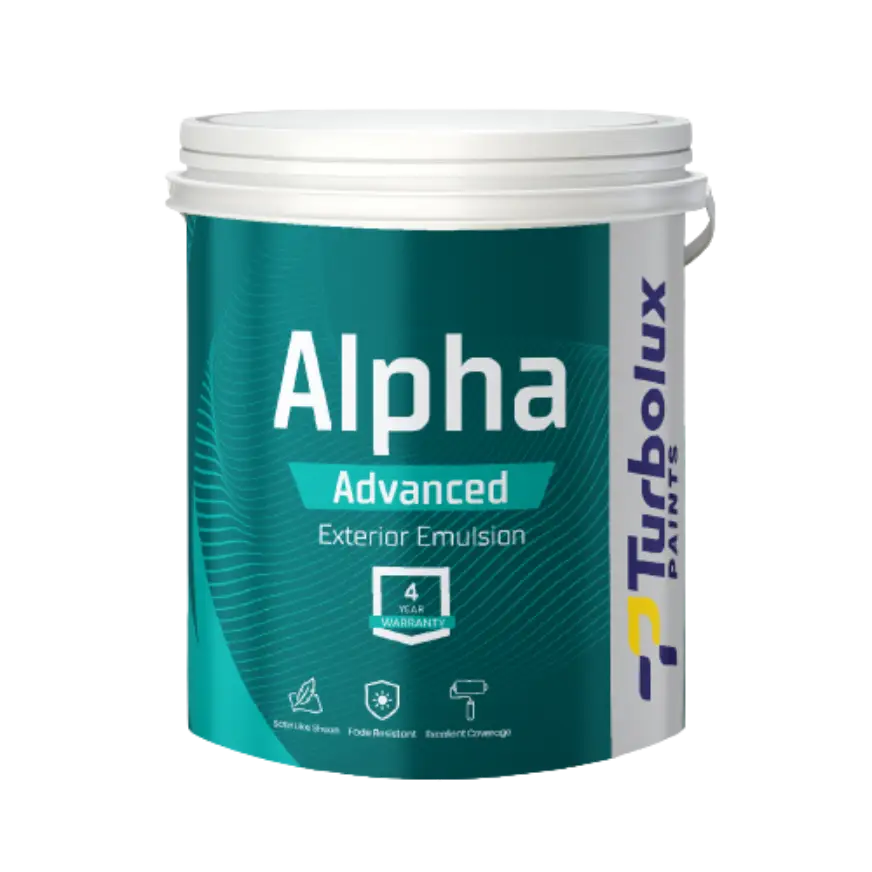
Satin sheen weather protection with over 1200 shades to choose from.
4+ Year WarrantyView Alpha Advanced →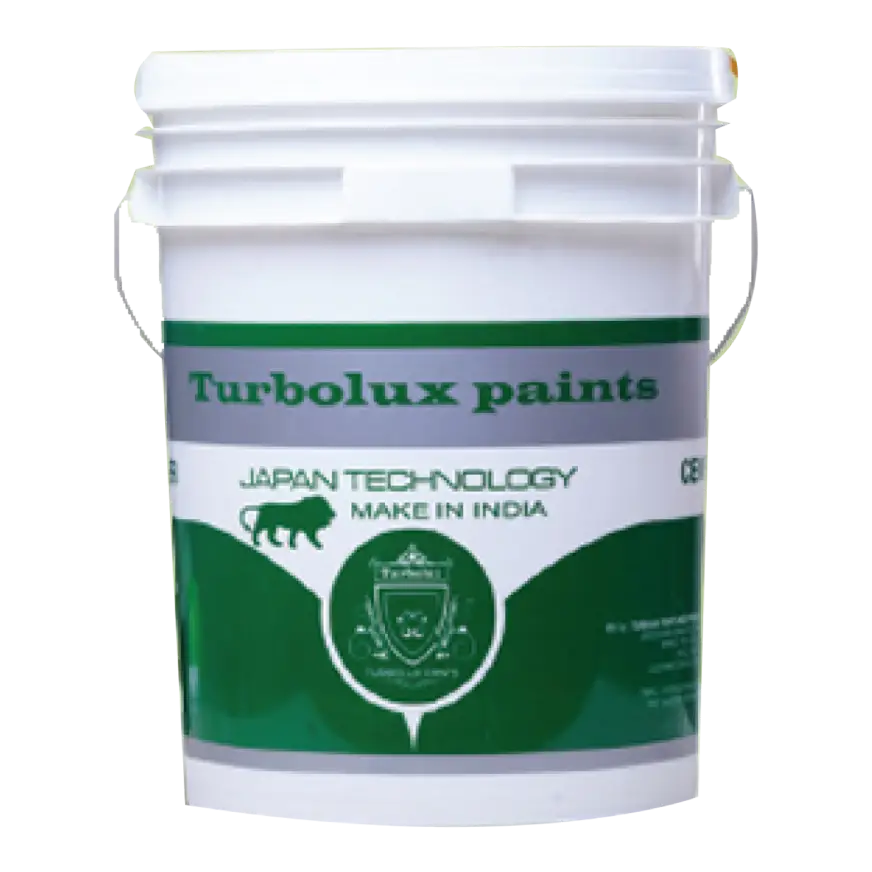
A water based fast drying primer that seals and prepares exterior walls.
Fast-Drying UndercoatView Exterior Primer →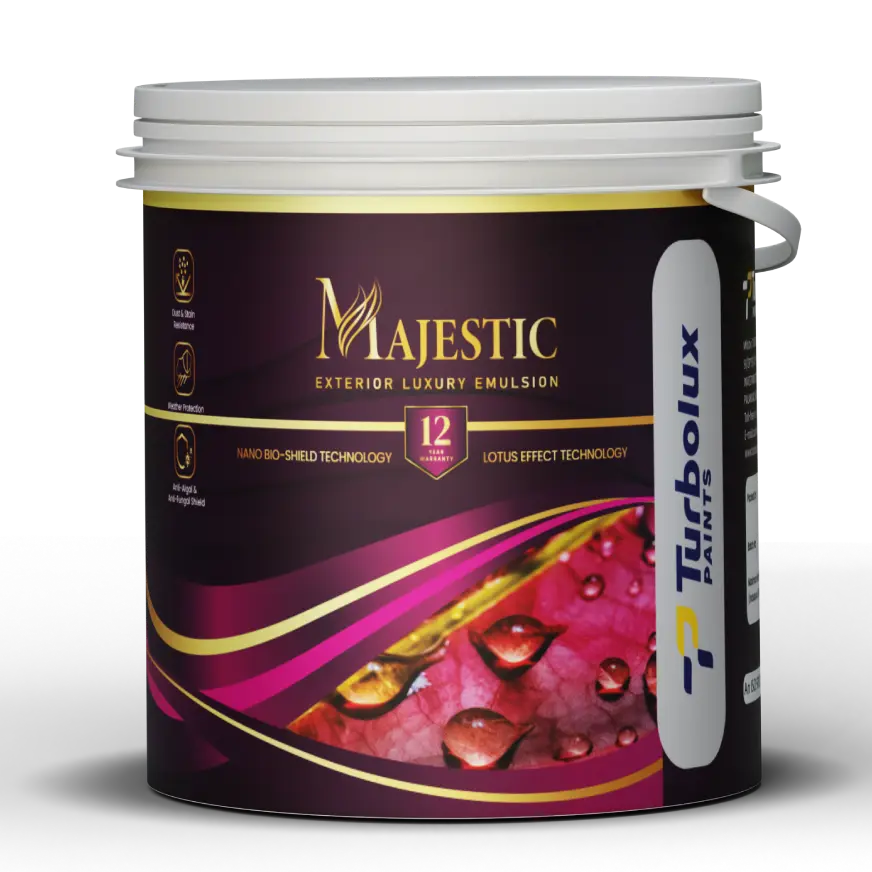
Lotus Effect self cleaning, Nano Bio-Shield and a crack resistant film.
12-Year WarrantyView Majestic →How do you check the job was done properly?
You cannot measure film thickness by eye, but you can check the things that produce it.
- Count the empty containers. Compare litres actually used against the measured wall area and the label coverage figure.
- Look along the wall, not at it. Stand close and sight down the surface. Thin areas show as slight sheen differences under raking light.
- Inspect corners and edges. Parapets, window reveals and the tops of walls are where coats get skipped. These are also where water enters first.
- Check the shaded elevation. North facing walls dry slowest and are most often recoated too early.
- Keep the batch details. Note the shade code and batch numbers for touch ups and for any warranty claim later.
Frequently asked questions
How many coats of exterior paint do I need?
One coat of exterior primer plus two full coats of exterior emulsion is the standard for Kerala homes. Add a third emulsion coat for deep or bright shades, when covering a much darker colour, or on rough textured plaster.
Is one coat of exterior emulsion ever enough?
No, not as a complete system. A single coat leaves thin spots and pinholes that let in driving rain and let UV break down the film. It typically fails within one to two years in a high rainfall climate.
How long should I wait between exterior coats?
Four to six hours in dry weather, six to eight hours or overnight during monsoon and on shaded walls. The surface must be dry all the way through, not merely touch dry, before the next coat goes on.
How much water should exterior emulsion be thinned with?
Roughly 20 to 30 percent for the first coat and 15 to 20 percent for the second. Over thinning is the most common cause of early failure because it leaves a dry film far thinner than the warranty assumes.
Does more coats mean the paint lasts longer?
Only up to a point. Protection comes from total dry film thickness, so two correctly applied coats beat three over thinned ones. Beyond the recommended system, extra coats mainly improve colour depth rather than durability.
Planning an exterior repaint?
Send us your wall area and shade choice and we will work out the exact litres and coat schedule you need.
Find your Turbolux paint →Made in Kerala for Kerala’s climate.