From lime wash to weatherproof emulsions: seven decades of how Kerala homes have been painted, and what that means for your next repaint.
Short answer: Kerala turns 70 on 1 November 2026. In that time, house painting here has moved from yearly lime wash, to distemper, to water-based emulsions, and now to weatherproof exterior emulsions with algae, fungus and dirt resistance. The biggest change is durability: a well-prepared exterior today can stay good for years instead of needing a fresh coat every summer.
Kerala was formed on 1 November 1956, when the Malayalam-speaking regions were brought together into one state. This Kerala Piravi is the 70th. It is a good moment to look back at how our homes have been painted, because the way Kerala paints its walls has changed as much as the homes themselves.
What did Kerala homes use before modern paint?
For generations, the most common wall finish was lime wash, known locally as chunnambu. Lime was mixed with water, sometimes with additives, and brushed on in thin coats. It gave a bright, clean white that suited laterite and plastered walls, and it was cheap and easy to apply.
Lime wash had one big weakness in Kerala: it did not last. Heavy monsoon rain washed it away, black algae patches appeared on shaded walls, and the surface turned powdery. That is why many families repainted every year, often before Onam or a family function. Timber, doors and windows were oiled or finished separately.
When did distemper and emulsions arrive?
Over the following decades, distemper became popular for interiors. It was easy to apply, came in more colours than lime, and looked smooth when new. In Kerala’s humidity, though, distemper tends to chalk, stain and attract fungus, which is why it often needs repainting within a few years. We explain this in detail in why distemper fails in Kerala.
Water-based acrylic emulsions changed the picture. They form a tougher, washable film that holds colour better and resists damp far more than distemper. Today, an interior emulsion such as Dew, with its whiteness and soft sheen, is the normal choice for living rooms and bedrooms across the state.
| Era (broadly) | Common finish | Typical life in Kerala | Main problem |
|---|---|---|---|
| Early decades | Lime wash (chunnambu) | About 1 year | Washes off, algae, powdery walls |
| Middle decades | Distemper | 2 to 3 years | Chalking, fungus, stains |
| Later decades | Acrylic emulsion | Several years | Needs proper primer |
| Today | Weatherproof exterior emulsion | Years, with warranties on premium ranges | Needs good surface prep |
What changed in exterior paints?
Exterior walls in Kerala face the toughest conditions: two monsoons, high humidity, strong sun and, near the coast, salt air. Modern exterior emulsions are built for exactly this. They add algae and fungus protection, UV resistance and better dirt pick-up resistance, so walls stay cleaner for longer.
Primers have improved too. A good exterior primer seals the plaster, controls alkali and helps the topcoat grip. Signature, for example, is a fast-drying water-based exterior primer with ceramic technology, anti-algal protection and 35% salt resistance, which matters for coastal homes. Read more in our coastal homes guide.
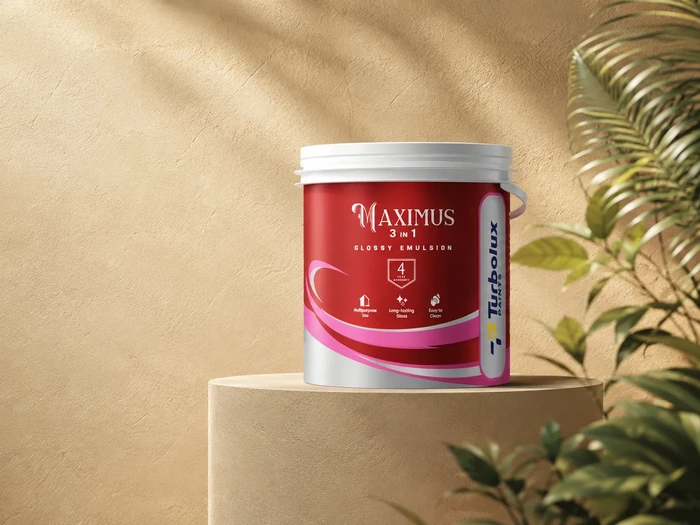
A 3-in-1 semi-sheen exterior emulsion that resists chalking, flaking and fading, with algae and fungus protection.
Semi-sheen · 4-year warrantyView Maximus →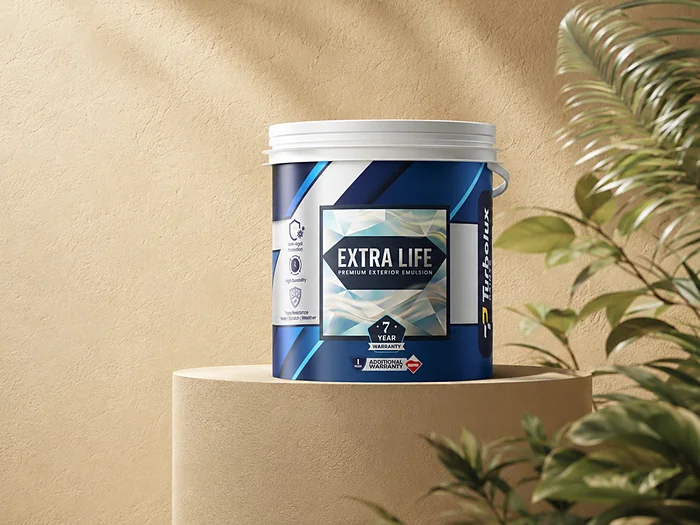
A semi-gloss exterior emulsion with DURASHIELD, advanced dirt pick-up resistance and algae and fungus protection.
Semi-gloss · 8-year warrantyView Extra Life →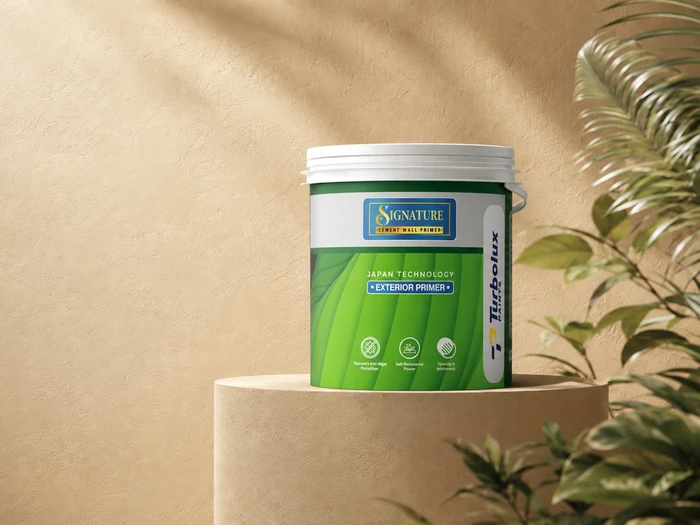
A fast-drying, water-based exterior primer with ceramic technology. Anti-algal, weatherproof and 35% salt resistant.
Exterior primer · Anti-algalView Signature →How have Kerala colour choices changed?
Lime wash meant almost every home was white. With tinting machines at the dealer, families can now choose from 1,260 Turbolux shades. Kerala homes have moved through phases of bright pastels, bold two-colour fronts and, more recently, a return to calm whites, creams and earthy laterite tones that echo traditional homes.
If you want a look that honours Kerala’s past, these shades pair the old lime-white feel with modern colour:
| Shade | Code · Hex | LRV | Character | Best for |
|---|---|---|---|---|
| Kappad Chalk | TLX-0061 · #F1F3F1 | 89 | Soft lime-wash white | Main exterior walls |
| Laterite Wash | TLX-0291 · #E0A47B | 44 | Warm laterite tone | Pillars, bands, boundary walls |
| Backwater Deep | TLX-0797 · #28B0A7 | 34 | Backwater teal | Doors, gates, accents |
| Kumkum Mid | TLX-0256 · #E17547 | 29 | Kumkum warmth | Feature wall or sit-out |
For more ideas, see our guide to traditional Kerala home colours and Kerala exterior colour combinations.
What does a good repaint look like in 2026?
The tools have changed, but the basics have not. A paint job lasts only as long as the surface under it. For a typical Kerala home, the sequence looks like this:
- Inspect for damp, cracks, algae and peeling. Fix leaks first.
- Clean the wall and treat algae or fungus patches.
- Apply a suitable exterior primer such as Signature.
- Apply two coats of a weatherproof exterior emulsion such as Maximus or Extra Life.
- Paint plinths, sit-out floors and metal work with products made for them.
Timing matters too. The dry months after the northeast monsoon are usually the best window, as covered in our best time to paint in Kerala guide. Extra Life carries an 8-year warranty and Maximus a 4-year warranty, so a careful repaint today can last far longer than the yearly chunnambu of the past.
Seventy years on, Kerala homes still want the same things: clean walls, cool rooms and a front that looks welcoming to guests. The difference is that today’s paint can deliver that for years, not months.
Frequently asked questions
When was Kerala formed?
Kerala was formed on 1 November 1956. Kerala Piravi 2026 marks the state’s 70th formation day.
What is chunnambu?
Chunnambu is the local name for lime. Lime wash was the traditional wall finish in Kerala before modern paints became common.
Why did old Kerala homes need painting every year?
Lime wash washes away in heavy rain, turns powdery and allows algae to grow, so it usually needed a fresh coat every year.
Is emulsion better than distemper for Kerala?
Yes. Emulsion forms a tougher, washable film that resists humidity and fungus much better than distemper.
Which Turbolux exterior paint is good for Kerala weather?
Maximus and Extra Life are both made for Kerala conditions, with algae and fungus protection. Extra Life has an 8-year warranty and Maximus a 4-year warranty.
Happy Kerala Piravi
Celebrate 70 years of Kerala with a home that looks its best. Visit your nearest Turbolux dealer to see shades and products.
Find a Turbolux dealer →90728 26662 · [email protected] · Happy walls in just a stroke.